How Custom Teak Deck Panels Are Made
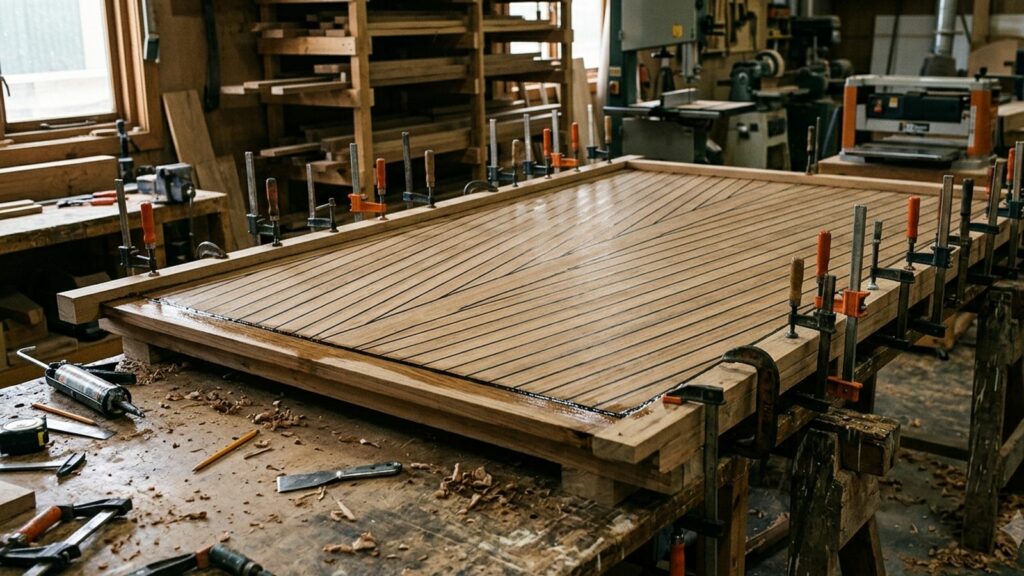
The finest teak decks are not laid plank by plank on an open deck in the sun. They are built as panels in a workshop, under controlled conditions, and fitted to the vessel as finished units. Prefabrication is what allows the precision, the tight seams and the clean curves owners associate with a first-class deck. Here is how a custom panel is made. You can see finished decks in our projects.
Templating the vessel
Everything starts from an exact record of the deck. The real geometry of the boat — its curves, margins and fittings — is captured by template or digital measurement, because no two vessels are the same and a drawing is never quite the deck. This record becomes the pattern every panel is built to.
Selecting and cutting the timber
Boards are chosen by grade and cut before anything is machined. FEQ, vertical-grain teak cut on the quarter is selected for its straight grain and dimensional stability. The planks are then dimensioned to precise tolerances; we subcontract CNC machining to a specialist partner, which lets each plank and curved margin be cut to the template exactly and repeatably.
Laying up and caulking the panel
The planks are laid up into panels and the seams are caulked in the workshop, on a flat reference surface, rather than on the moving, exposed deck of a boat. Working indoors means the primer, bond breaker and sealant are applied in stable temperature and humidity — the conditions that decide whether a seam lasts. The result is a panel with even, consistent seams that would be far harder to achieve in the open.
Bonding — no plugs, no screws
Panels are engineered to be bonded to the sub-deck in a flexible marine adhesive, with no fastenings piercing the wood. This is the modern standard: no plug holes to leak, no metal to corrode, load spread across the whole panel, and a thinner, lighter build for the same working life. It also means the finished deck shows an unbroken run of grain, without the rows of plugs of an older screwed deck.
Fitting aboard
Because the panels are finished before they reach the vessel, time on board is reduced to preparation, bonding and final finishing. The sub-deck is prepared, the panels are bedded down under weight or vacuum, the seams are dressed, and the deck is sanded fair. The heavy, precise work has already been done ashore — which is why prefabrication also shortens the vessel’s time out of use.
Conclusion
A custom teak panel is where accuracy is built into a deck: templated to the real boat, cut to tight tolerances, and caulked and bonded in controlled conditions. It is the difference between a deck that fits and a deck that merely covers. Prefabricated panels are how we build decks to last, and they sit at the heart of the refit process. To discuss a bespoke deck for your vessel, our team is ready to review the project.
A question about your teak?
Deck condition, remaining thickness, whether to sand or replace: we give an honest opinion.
Ask my question →