Teak Deck Repair vs Complete Replacement
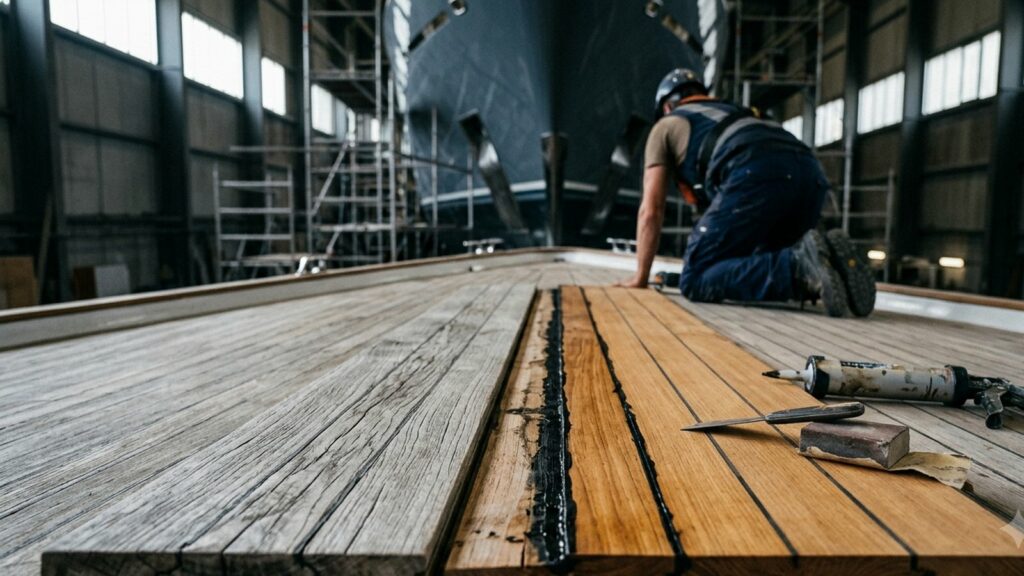
A teak deck rarely fails all at once. It ages in parts — a seam here, a soft plank there — and the real decision an owner faces is when patient repair stops making sense and replacement becomes the better spend. Get that judgement right and you save both money and the boat. Get it wrong in either direction and you pay twice.
What repair can fix
Most of what goes wrong with a deck is at the seams, not in the wood. Caulking hardens and lifts with age; re-running the seams — cutting out the old sealant and laying fresh — restores the deck’s seal and buys many more years. A single cracked or lifted plank can be cut out and replaced without touching its neighbours. A failed section of a bonded deck can be re-bonded. As long as the planks still carry enough thickness, this kind of repair is almost always the right answer: a fraction of the cost, and it keeps the deck you have.
When replacement is the honest call
Thickness sets the limit. Once the planks have worn thin enough that the seams no longer hold their depth, or the wear is reaching the fixings, repair becomes a series of temporary fixes on a deck that has spent its life. Widespread cupping, seams opening across the whole deck, and water tracking beneath many planks are signs of a deck at its end, not one that needs a patch. Repairing it well can cost nearly as much as replacing it and last a fraction as long.
The cost trap of repeated repairs
The tempting middle path — repairing a tired deck a little at a time — is often the most expensive. Each visit carries mobilisation, access and labour, and a patched section beside worn teak simply fails again next to the patch. Two or three rounds of this can exceed the price of a clean replacement while leaving you with a deck that still looks and behaves its age. When a deck is genuinely near its end, replacement is usually the cheaper answer over any horizon longer than a season or two.
How to decide with confidence
The test is not the deck’s age but its remaining thickness and the state of the wood beneath the seams. A twenty-year-old deck laid thick and cared for may need only new caulking; a young deck of thin, poor timber may be past saving. A proper survey measures seam depth, checks for cupping and soft spots, and looks beneath the planks for water. Only then can anyone tell you honestly which side of the line your deck sits on. For a recent example, see our 60 m² teak deck rebuilt from scratch in Saint-Martin.
Conclusion
Repair protects a deck that has life left; replacement renews one that does not. The wrong call in either direction is expensive — replacing a deck that had good years left, or pouring repair into one that had none. If you are unsure where yours stands, we survey the deck before advising, and recommend the option that serves the vessel, not the larger invoice. For the full renewal path, see our guide to the teak deck refit process.
A question about your teak?
Deck condition, remaining thickness, whether to sand or replace: we give an honest opinion.
Ask my question →