Signs Your Yacht Teak Deck Needs Replacement
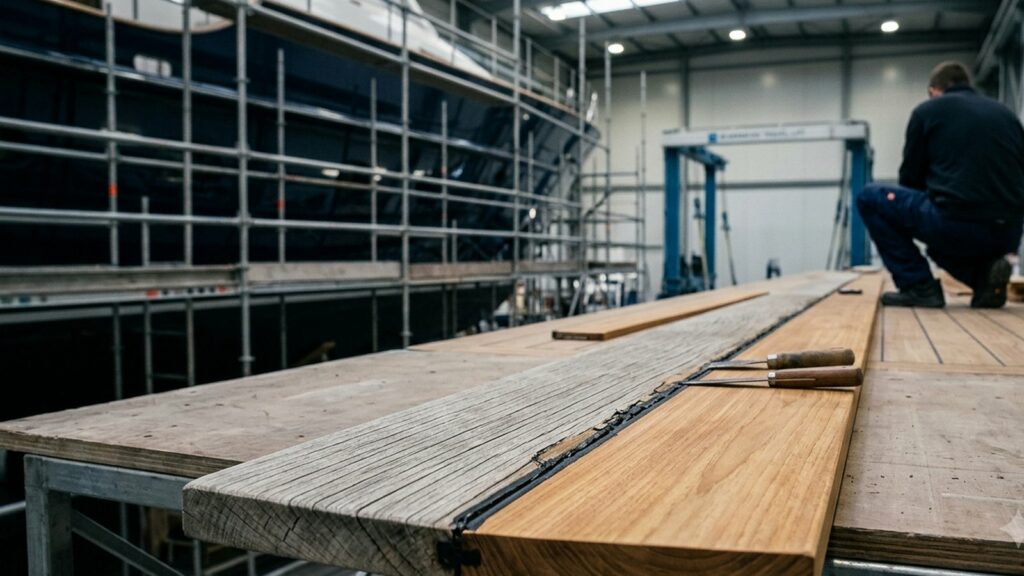
Owners often ask us to look at a deck because it has gone grey, and grey is almost never the reason to replace one. A silvered deck is usually a sound deck that has simply lost its surface oils. The signals that actually matter are structural, and they are easy to miss until water has already found its way beneath the planks. Here is what to look for, and what each sign really means.
Shallow or failing caulk seams
The black seams should sit slightly below the surface of the teak. When the planks have worn down to the level of the caulk — or below it — the seam can no longer hold or protect the edges of the boards. You will see caulk standing proud of the wood, or lifting and peeling along its length. Isolated seams can be re-run; when it is happening across the whole deck, the teak itself has run out of thickness.
Cupping, checking and splitting
Run a hand across the planks. If they are dished or raised at the edges (cupping), or show fine surface cracks that follow the grain (checking), the wood is moving more than it should. A little is normal with age; widespread cupping means the boards are thin, poorly cut, or both, and no amount of sanding will flatten them without spending the last of their thickness.
Exposed fastenings or plugs
On a screwed deck, teak plugs cover the screw heads. When wear reaches the plugs — or they begin to pop out — the screws below are exposed to water, and the fixing itself is compromised. On a bonded deck, the equivalent warning is planks that sound hollow or lift underfoot, meaning the adhesive bond has failed and water is tracking beneath.
Water beneath the planks
This is the most serious sign and the hardest to see. Dark staining that spreads from the seams, soft or spongy areas, or a persistent damp smell in the spaces below indicate water is getting under the deck. Left alone it reaches the sub-deck and structure, turning a deck job into a far larger repair. If you suspect it, act before the next season.
How to tell repair from replacement
One or two of these signs, in a limited area, usually points to repair: re-run the seams, replace a plank, re-bond a section. When several appear together and across the whole deck — shallow seams, general cupping, failed fixings, water intrusion — the deck has spent its life and repair becomes a series of temporary fixes. The deciding measurement is remaining thickness: below roughly 4 mm of usable teak, there is little left to work with.
Conclusion
Colour is cosmetic; thickness and water are structural. A grey deck may have years left, while a golden one hiding damp seams may not. When in doubt, a proper survey — measuring seam depth and checking beneath the planks — settles the question before it becomes expensive. If your deck is showing any of these signs, we can assess it and tell you honestly whether it needs repair or replacement.
A question about your teak?
Deck condition, remaining thickness, whether to sand or replace: we give an honest opinion.
Ask my question →